Making a claim
What Evidence Do You Need For A Deposit Claim?
Proof you paid the deposit, your tenancy agreement and any renewals, scheme search results, and messages with your landlord or agent. Missing something? There is often another way.
Calculate What You Could ClaimFree to check · 60 seconds · No win, no fee
In Short
For a tenancy deposit claim in England, you need to show that you paid a deposit, when your tenancy and any renewals started, and that the deposit was not protected in time or you did not get the prescribed information. Useful evidence includes a bank statement or receipt, your tenancy agreements, screenshots of your DPS, TDS and mydeposits searches, and emails or texts with your landlord or agent.
The Evidence To Gather
- Proof you paid the deposit: a bank statement, transfer or receipt
- Your tenancy agreement, plus every renewal or new agreement
- Any deposit certificate or scheme paperwork you were given
- Search results from DPS, TDS and mydeposits, as screenshots
- Emails, texts or letters with your landlord or agent
- Photo ID, such as a passport or driving licence
What Each Piece Shows
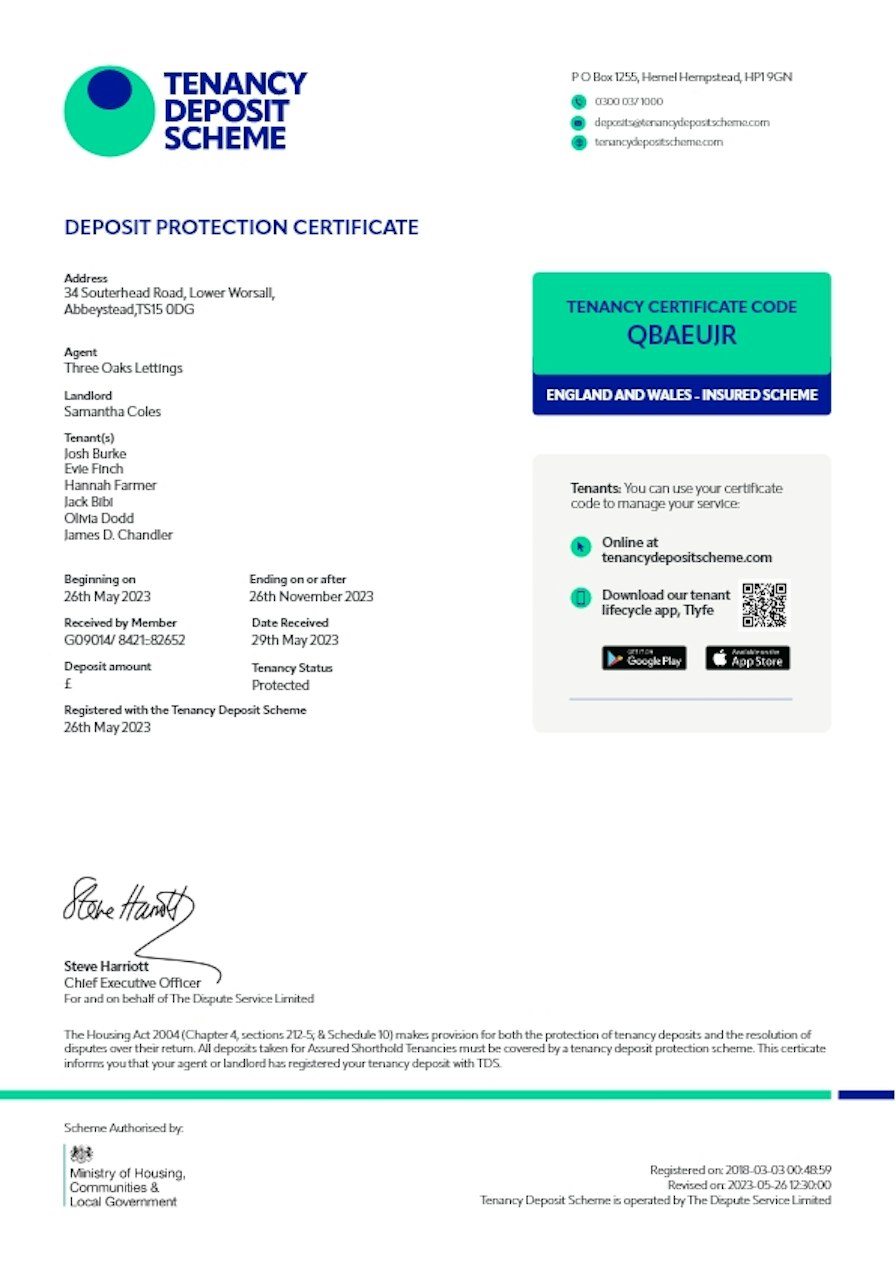
Keep Any Scheme Paperwork
The law requires the prescribed information, not always this exact certificate. Keep whatever you received, and note the date. If you got nothing at all, tell us.
Missing Something? Try This
- Lost the tenancy agreement
- Paid the deposit in cash
- No written agreement at all
- Not sure which scheme
- Search your emails, or ask the agent for a copy
- A receipt, cash withdrawal, or a message about it
- Rent payments and messages can show the tenancy
- Search all three schemes and keep the results
Do Not Have Everything?
That is common. You do not need a perfect file to start. Take our deposit check, see how to check the schemes and what prescribed information is. Renewed more than once? Read about renewed tenancy claims.
Here's What You Get When Working With Us
Recommended
 With Free Deposit Check
- Full online deposit check and analysis
- All three deposit schemes searched for you
- Eligibility and time limits checked
- Your whole case file prepared
- Matched with our specialist solicitors
- £387 court fee covered in your agreement
- With you at every step
- £0 up front and £0 if you lose (terms apply)
- Search each scheme yourself
- Work out if you qualify
- Gather and organise all the evidence
- Write the letter to your landlord
- Pay the £387 court fee up front (Help with Fees may cut it)
- Present your case to the court
- Chase your landlord for payment
- All the risk and work is on you
If you win, the solicitor's success fee (up to 25% + VAT) comes out of your compensation. The solicitor pays us for the introduction, so you never pay us anything.
Quick Answers
What Evidence Do I Need For A Deposit Claim?
Proof you paid the deposit, your tenancy agreement and any renewals, results from the three scheme searches, and messages with your landlord or agent. The solicitor will also ask for photo ID.
I Lost My Tenancy Agreement. Can I Still Claim?
Possibly. Search your emails for the signed copy and ask the agent or landlord for one. Rent payments and messages can also help show when the tenancy started.
I Paid My Deposit In Cash. Does It Count?
Yes. The Housing Act 2004 says money includes cash. A receipt, a cash withdrawal on your bank statement, or messages about the deposit can help show you paid.
How Do I Show My Deposit Was Not Protected?
Search DPS, TDS and mydeposits and keep screenshots. Citizens Advice suggests emailing each scheme and asking them to confirm it was not protected, or was protected late.
Keep Reading
Sources
- Housing Act 2004, section 212 (legislation.gov.uk)
- Housing Act 2004, section 213 (legislation.gov.uk)
- Housing Act 2004, section 214 (legislation.gov.uk)
- How to make a tenancy deposit compensation claim (Shelter)
- Check your tenancy deposit is protected (Shelter)
- Tenancy deposit protection prescribed information (Shelter Legal)
- Private tenancy agreements (Shelter)
- Taking your landlord to court if they haven't followed the deposit rules (Citizens Advice)
Last updated 16 October 2026. General information for tenants in England only (the rules differ in Wales, Scotland and Northern Ireland). Not legal advice.